
Ulaanbaatar, Mongolia, July 30, 2022 - Today is World Day Against Trafficking in Persons. Since 2014, World Day Against Trafficking in Persons has been held on July 30th annually. This year’s theme focus on the role of technology as a tool that can both enable and impede human trafficking.
Millennium Challenge Account–Mongolia (MCA-Mongolia) has a zero-tolerance policy against trafficking in persons and has been implementing trafficking in persons prevention and response plans. MCA-Mongolia’s prohibition on trafficking in persons is also embedded in all MCA-Mongolia contracts with partners and contractors and requires large-scale infrastructure contractors to develop and implement their own Counter-Trafficking in Persons plan. As part of these plans, MCA-Mongolia requires contractors to implement counter-trafficking in persons activities including awareness raising to workers and the community, and develop effective mechanisms to report and resolve potential incidents or allegations in a survivor-centered manner.
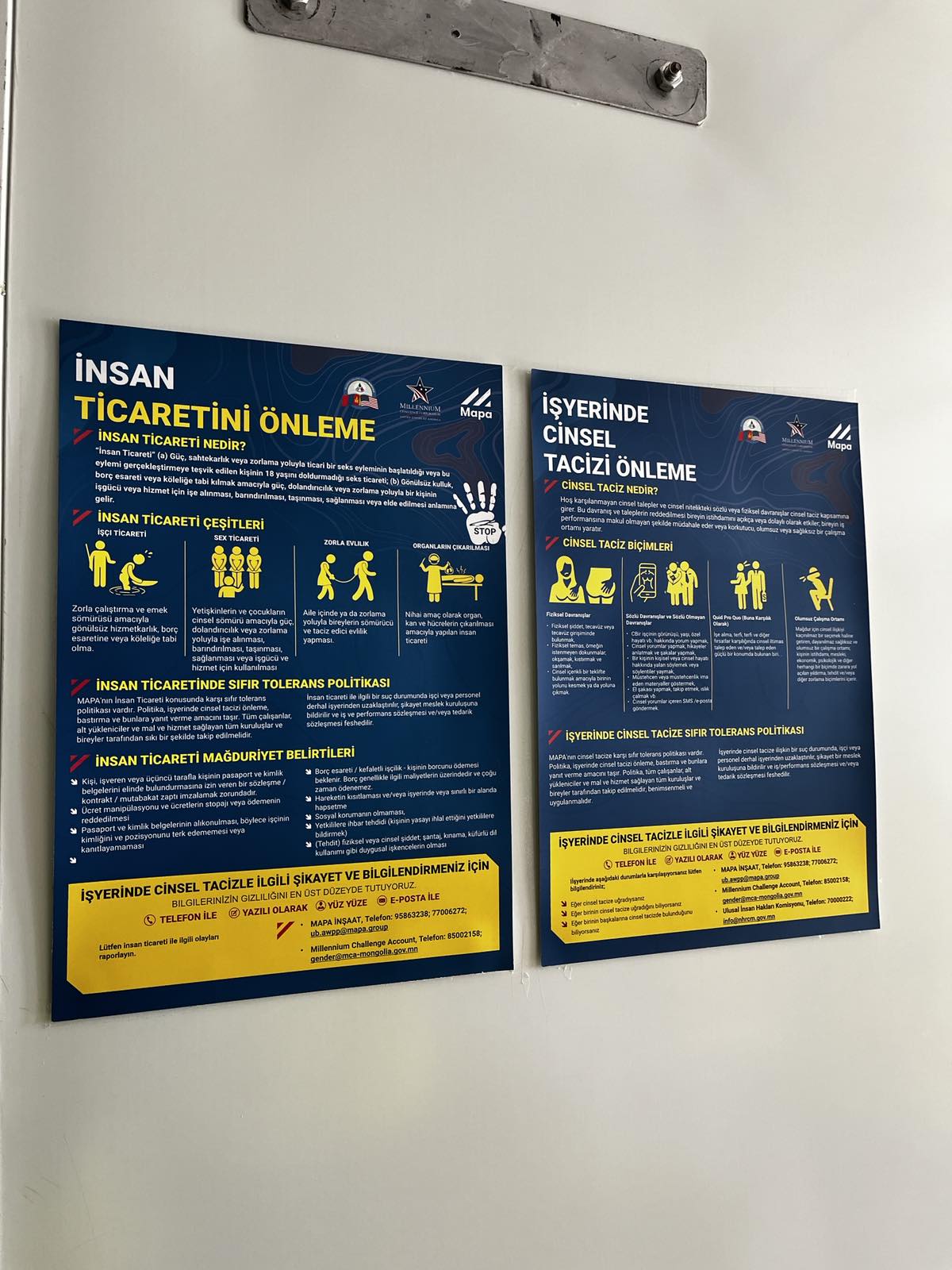
According to the United Nation’s data, thousands of men, women, and children fall into the hands of traffickers through the use of force, fraud, or coercion every year, in their own countries and abroad. Almost every country in the world is affected by trafficking, whether as a country of origin, transit, or destination for victims. Most of the victims of trafficking in persons are women and children, and it often manifests itself in the forms of sexual slavery, forced labor, and cross-border labor exploitation.
Since joining the UN’s Protocol to Prevent, Suppress, and Punish Trafficking in Persons in 2008 and passing the Law on Combating Human Trafficking in 2012, Mongolia has been building toward strengthening mechanisms of protection and support services to survivors and victims.
According to the annual “Trafficking in Persons” report published by the U.S. State Department, Mongolia is ranked as Tier II in 2022 for its efforts toward combating trafficking in persons. This indicates that the Government of Mongolia has not fully met the minimum standards to eliminate trafficking in the country but has taken steps to do so. According to the report, Mongolia is both a source of and a destination for trafficked persons, both for sex and forced labor purposes. A significant number of Mongolian victims are trafficked to Ulaanbaatar and the surrounding areas for sex trafficking, most originating from rural and poor economic areas throughout the country. The report also highlighted that due to the inconsistency and lengthy judicial system in Mongolia, perpetrators often face reduced sentences.
Report any suspicion of Trafficking in Persons!
If you have any information related to Trafficking in Persons or if you are a victim or witness, please contact the below hotlines.
Police emergency number: 102
Child helpline: 108
Trust helpline: 1800-1903
Unbound Mongolia: 7575-7875
If you have any information related to Trafficking in Persons for MCA-Mongolia projects, please call +976 8500-2158, +976 7711-1710, or email at info@mca-mongolia.gov.mn. We will keep whistleblower confidentiality.
###
This $462 million project is a partnership between the American and Mongolian people made possible by $350m in MCC grant funding and the $111.78m contribution from the Government of Mongolia which demonstrates their commitment to working together to achieve economic growth and poverty reduction in Ulaanbaatar. The Mongolia Water Compact is funding major infrastructure projects, including the construction of new wellfields and two large plants - an Advanced Water Purification Plant and Wastewater Recycling Plant which will be the first of their kind in Mongolia. In addition, the Compact will invest in policy measures to create a financially and environmentally sustainable future for the water sector of Ulaanbaatar. By 2026, the water system in Ulaanbaatar will have been expanded to deliver 80% more drinking water, allowing for the city’s future expansion.