
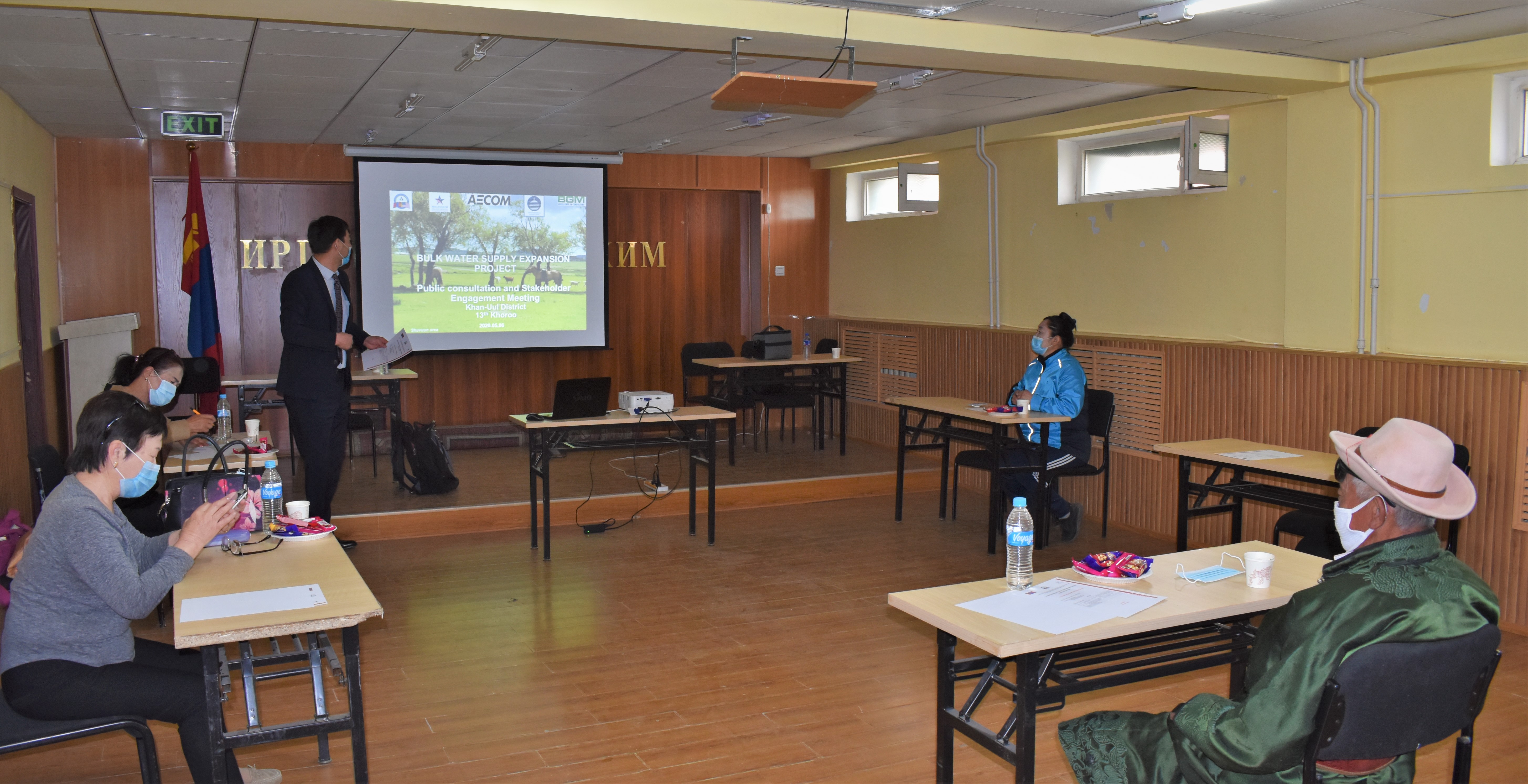
During the introduction of the Downstream Wells Activity, 10th khoroo, Khan-Uul district, Ulaanbaatar, May 4, 2020
[Ulaanbaatar, May 11, 2020] – As the accountable entity to implement the Mongolia Water Compact, MCA-Mongolia organized public consultation and stakeholder engagement meetings at Khan-Uul district from May 4 to May 6, 2020. The meetings introduced and collected feedback on the detailed design work of the Downstream Wells Activity, a key component of the Compact.
The public consultations aimed to deliver a general introduction of the Downstream Well Activity, Environmental and Social Impact Assessment (ESIA), and Detailed Environmental Impact Assessment (DEIA) activities to the public and were held at both the 10th and 13th khoroos of Khan-Uul district with attendance of 93 people. Attendees represented governing bodies, businesses, local households, and herders’ communities.
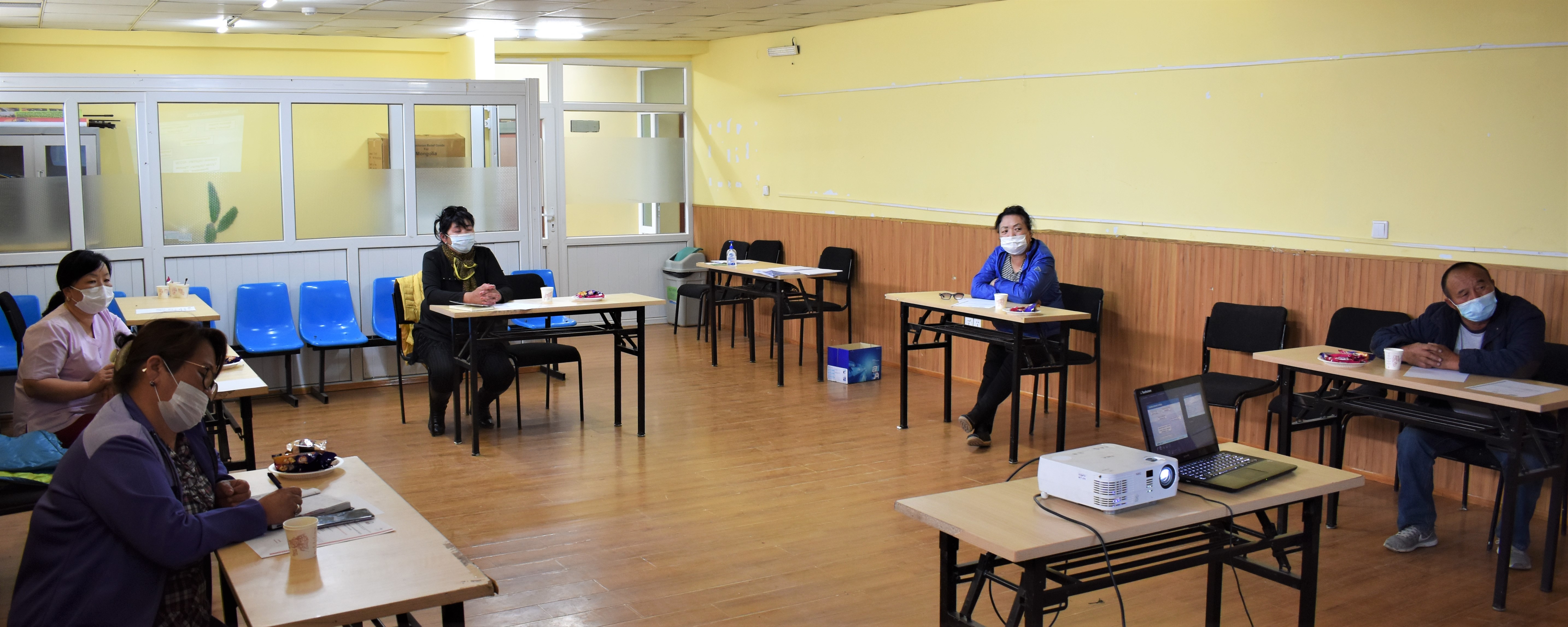
Each session was organized in accordance with COVID-19 related government restrictions, 13th khoroo, Khan-Uul district, Ulaanbaatar, May 5, 2020
In accordance with the regulations set by the Government in response to the COVID-19 pandemic, the public consultations were organized by gathering no more than five people at the same time, limiting the duration of each session to one hour, and ensuring required distance between the participants. In addition, the team made sure that the body temperature of each participant was measured, masks and hand sanitizers were provided and venues were cleaned before each session.
At the beginning of each session, representatives from MCA-Mongolia and AECOM, MCA-Mongolia contractor, provided a brief introduction of the Downstream Wells Activity and its detailed design work as well as the Environmental Social Impact Assessment (ESIA) and Detailed Environmental Impact Assessment (DEIA). The introductions were followed by Q&A sessions, focus group interviews and household surveys.
During the consultation, participants extended their appreciation to MCA-Mongolia for its mission to provide sustainable water supply to the people of Ulaanbaatar and its efforts to reach project-affected communities and public stakeholders during the pandemic.
Participants reported a clear and accurate understanding of the Mongolia Water Compact. People were excited about the introduction of advanced water technologies used in developed countries including the advanced water purification plant, the first of its kind in Mongolia, which will be a solution to the downstream water pollution around the Shuvuun and Biokombinat wellfields. Some participants found the construction of AWPP as a career opportunity for their children and expressed their willingness to have future water engineers in their families.
In addition, the project team explained that the construction of downstream wellfields will create favorable conditions for the expansion of the capital city to the west. Redevelopment of ger areas will promote more citizens to move into houses and apartments connected to central water and wastewater systems.
Participants also expressed concerns. Many of the participants raised concerns about the issues of environmental pollution and the exposure of groundwater caused by gravel quarries near the river. In response, the project team shared efforts and measures from the relevant ministry to resolve gravel quarries-related issues.
Participants were also pleased to be able to have scientifically sound and professional answers to their questions about whether the extraction of water from the Shuvuun and Biokombinat wellfields would affect the flow of the Tuul River or the water level of wells used for agriculture and animal husbandry around the area.
The project implementing team also noted it has already been working to anticipate noise and dust issues during the construction period. “MCA-Mongolia is committed to ensuring that the construction companies exercise specific standards and guidelines in order to prevent disturbance,” stated the project team.
All attendees actively participated in the discussions and expressed their willingness to support the project at the end of every session.
On May 05, 2020, MCA-Mongolia and AECOM teams organized a stakeholder engagement meeting at the Governor’s Office of Songinokhairkhan district to provide introduction and progress updates regarding the project. The meeting was attended by Mr. Tumurbaatar, head of Governor’s Office of Songinokhairkhan district, and Kh. Nemekhbayar, J. Gantogtokh, and B. Sukhbaatar, governers of khoroo number 20, 22, 32, respectively.
During the first stakeholder engagement meeting, MCA-Mongolia and AECOM representatives provided general information about the Downstream Wells Activity and the main layouts of the finished water pipeline which will go through the area. The second meeting was held on May 08, 2020 where modifications to the raw water pipeline design were introduced to attendees including Ms. Batchimeg, head of the Land Management Department of Khan-Uul district, and land specialist B. Gonchigdorj. The parties agreed to have another discussion after exchanging more detailed information on May 11th, 2020.
All the representatives from governing bodies, businesses, local households, and herders’ communities of Khan-Uul and Songinokhairkhan districts expressed their sincere willingness to support the Compact implementation, including the DWA project and readiness to collaborate when needed.
###
Millennium Challenge Account - Mongolia is a state-owned enterprise established by the decision of the Government of Mongolia on October 3, 2018, pursuant to Government Resolution No 297 in accordance with Section 3.2 of the Compact to implement the Program under the 350 million USD Mongolia Water Compact signed with the Millennium Challenge Corporation, a U.S. government foreign aid agency.
The Millennium Challenge Corporation is an independent U.S. government agency working to reduce global poverty through economic growth. Created in 2004, MCC provides time-limited grants and assistance to poor countries that meet rigorous standards for good governance, from fighting corruption to respecting democratic rights. Learn more about MCC at www.mcc.gov.